Thursday, 26 March 2009

Gijón

It’s a coastal industrial city and a municipality in the autonomous community of Asturias. Gijón is the most thickly populated city and finds its origins in the Roman settlement of Gigia. From those times remain the thermal baths and the surrounding wall. It is close to the other main Asturian cities, Oviedo and Avilés.
The climate is Atlantic with mild temperatures and high humidity throughout the year. The summers are very warm and winters are cold with significant rains, especially in December and March.
For much of the twentieth century the town was heavily dependent on mature heavy industries but in the 80’s tertiary sector employment began to expand quickly along with the city’s population which by 2007 stood officially at 277.897 for Gijon proper, and approximately 380.000 for the total Gijón agglomeration.
The port is at the centre of many of the local businesses. Apart from this, the economy is based on tourism, steel (Arcelor), other metallurgy, livestock rearing and fisheries.
Overlooking the city from the hill Cerro de Santa Catalina is Chillida’s sculpture Elogio del Horizonte, symbol of the city.
Going downwards the quarter of Cimadevilla, with its narrow streets and small squares invites to drink a Sidra (the typical Asturias drink).
Near here you can find Jovellanos Square where the Museum-Home of the Asturian erudite stands.
Gijón is nowadays a modern and lively city, especially in summer when it becomes the most important receptor of tourists in the region.
Come and know us!

Miriam Seivane
Friday, 13 March 2009

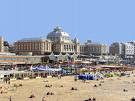
This is Scheveningen


Scheveningen is a former small fishing community located between the sand dunes at the west coast of The Netherlands. 700 years ago the small village was known as Sceavian which is the old English word for ‘lookout’. Nowadays a few local people still use the dialect consisting of quite a lot of words which are connected to the English language. Approximately 60.000 people live in Scheveningen and due to a collapse in the fishing industry in the seventies just a small number is still working on local fishing trawlers or in fish processing plants. The presence of beautiful sandy beaches and several attractions make Scheveningen as the biggest coastal resort with an annual average of 16 million visitors. Scheveningen is not an independent town, but part of The Hague. A local political party serve the interests of the inhabitants Scheveningen.


This contribution comes from Willem Ment Den Heijer, geography teacher of T2A (the Dutch Selhovians) and he was born in Scheveningen. He inivites his friends from Cudillero to write about their fishing harbour!! Just drop a line!!

Sunday, 8 March 2009

Hans Smit of Hofstad Lyceum visited IES Selgas

Hans Smit, geography teacher of Hofstad Lyceum in The Hague (Holland) came over to Cudillero and stayed two schooldays long at IES Selgas. He both gave lessons (in English) and attended lessons (in Spanish). He had prepared an interactive presentation, not only for the bilingual students (the “Selhovians”) but also for the “bahilleratos” and the teachers who form the “speakers group” on Friday morning. His story was about The Netherlands, focusing on water management. His audience had to find out what makes The Netherlands so special. Every student got two hand-outs to be filled in, one of them being a criss cross puzzle. The pupils were very interested in the film “A closer look at The Netherlands”, which supplied them with all the information they needed for their assignments. The guest teacher from “Los Países Bajos” had also brought along some typical Dutch candies: drop and stroopwafels. Everybody seemed to appreciate that.

Mr. Smit also followed some lessons given by his IES Selgas colleagues in order to enhance his command of the Spanish language. Most interesting was a geography lesson about the Ciudad Astur, which is in many ways comparable to The Greenheart Metropolis (Randstad Holland) in The Netherlands. He was sitting next to “his” Selhovian student Ruben during the Spanish lesson, took part in a flute concert organized by music teacher Francisco and laughed a lot during a well organized debate about sex-related issues!!
During a nice meal after an inspiring school day at Selgas, Hans Smit discussed together with principal Ana and Head of Studies Francisco the future of the exchange project between IES Selgas and Hofstad Lyceum. The three of them agreed: exchanging knowledge and experiences is a real contribution to up-to-date education. ¡Viva la internacionalización! ¡Viva Europa!

Thursday, 19 February 2009

Saint Valentine’s Day

On February the 14th, we celebrate Saint Valentine’s Day. As you know it is the traditional day on which lovers express their love for each other by sending Valentine’s cards, presenting flowers, or offering confectionary.
In this school, students in the Fourth course always go on a trip to celebrate they finish their Secondary Education, so they took this opportunity to earn some money to help them in their school trip.
They made some paper flowers and everybody in the school could send a flower with a note to a boy or a girl in the form of “valentines”.

There are us wearing Valentine’s symbols.

If you want to see more photos click here. We hope you like them.

Friday, 13 February 2009

Videoconference


Last week some students from Selgas School had the opportunity to share a lesson with students from Hofstad Lyceum. It was a new learning experience through videoconference with an extremely interesting presentation offered by Bjorn Klinkenberg with the title: "Racism, migration and gender". Next week, Pilar Cuello, from the Teacher's Training Center of Avilés, will give the second lesson, on "Gender" this time.
Selgas School is really involved in this project and wants to thank Hofstad Lyceum for their encouragement and support to carry it out.
Ana Peláez
Selgas Secondary School Principal

Thursday, 12 February 2009

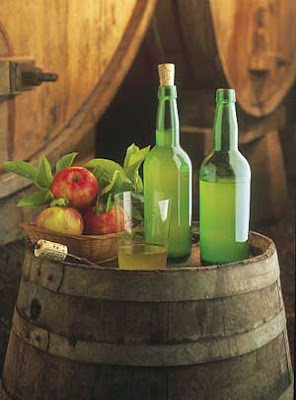
Cider

Cider is a traditional drink that is made from apples. This drink consists of fermented apple juice. It’s very popular in Asturias.
It’s made in a ‘llagar’. Apples are collected from the trees and stored until they are ripe. Then, they are crushed to get the liquid. The cider is kept in big barrels until it ferments. Then, it is bottled and sold. There are two types of cider: the acid cider has alcohol. The sweet cider hasn’t got alcohol.

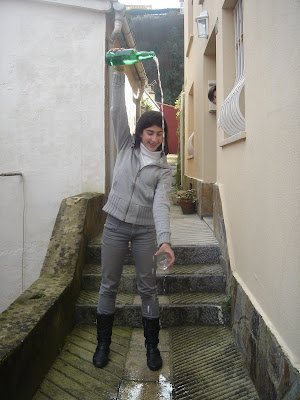
It is peculiar the way it is served. In this ritual the cider must be ‘escanciada’. The taste is different when a good ‘escanciador’ (person who serves the glass of cider) works properly:He (or she) rises the bottle over his head and makes the cider fall against the edge of the glass. When it strikes the glass it becomes oxygenated. That action is called ‘escanciar’. Then, you must drink it at once. You don’t drink it all. Some dregs stay at the bottom of the glass.

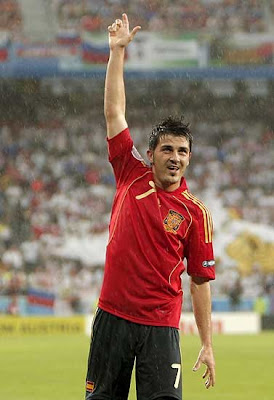
That´s the way you have to "escanciar" (Villa is from Asturias and he knows it well)

It is drunk in traditional festivals in Asturias like the ‘Amagüestu’. In this festival adults and children drink cider and eat roasted chestnuts. Children drink sweet cider, of course!. Adults always take the alcoholic drink and sometimes, when the party finishes, they are not very sober.

Here is Marina showing us how to do it

Cider is popular in Asturias because we used to have a lot of apple trees and lots of apples every two years (there’s a good harvest every two years). It is drunk since the Roman period. In the nineteenth century they started to bottle it. They started to ‘escanciar’ it.

Yurena Gancedo y Marina Granda

Monday, 9 February 2009

Mirian´s family

My name is Mirian, I live in Asturias, in the north of Spain. We are a common family: my mum, my dad, my sister and me.
My mum is called Juana. She is forty-six years old. She is a cleaner and she works in a hotel near our town. My dad is called José Ramón. He is a fisherman. My sister’s name is Noelvis. She is twenty-four year old. She doesn’t work. She is a student. She is studying at University in Gijon. My aunt lives ten kilometres away from us. She has got tree children: Angel Roberto is thirty years old; Patricia is twenty-eight yeas old and Dario is twenty-five years old. I like playing football with my cousin Dario.I also have another cousin Abraham. He is five years old. My little cousin is very nice. He says that he wants to marry me. My grandfather, my mother’s father, lives alone in a house, near us, so I can spend a lot of time talking with him. He isn’t mean and he sometimes gives me some money.

Write to me soon. Kisses.
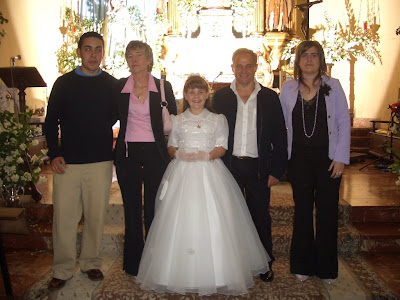
This is me, with my parents, my sister and my brother in law in the day of my First Communium